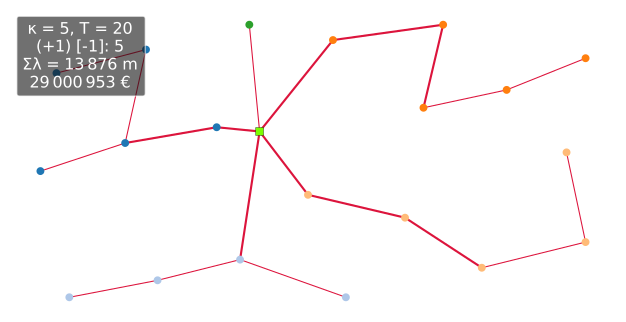
Simple TOPFARM Example
This notebook walks through a minimal wind-farm design optimization that couples OptiWindNet (electrical-network routing) with TopFarm (turbine-layout optimization), and uses the standalone ``costmodels`` package for offshore CAPEX/OPEX and project finance.
Three cost components:
Energy (AEP): PyWake evaluates farm energy for a set of wind directions and turbine coordinates.
Electrical network (cabling): based on turbine/substation coordinates and the cable catalogue,
WFNComponent(a TopFarm wrapper around OptiWindNet’sWindFarmNetwork) returns cabling cost (and gradients).Economics (NPV): a
costmodels.project.Projectwith aTechnologybacked byDTUOffshoreCostModelreturns project NPV given AEP and cabling cost. NPV is the optimization objective (maximize=True); IRR, LCOE, CAPEX and OPEX are tracked as auxiliary outputs.
Design variables — the optimizer is free to move:
x,y: turbine coordinates (one entry per turbine)xs,ys: substation coordinates — letting TopFarm co-locate the substation alongside the turbines reduces total cabling cost. The boundary constraint applies to turbines only; the substation is unconstrained, so its trajectory may exit the site polygon. The final substation position is shown in a dedicated trajectory plot at the end.
How it plugs into TopFarm
We instantiate each component:
aep_comp,network_cost_comp, andnpv_comp.We combine them in a
TopFarmGroup([aep_comp, network_cost_comp, npv_comp]). With promotion, outputs/inputs line up automatically:aep_compproduces AEP → used by the economic component.network_cost_compproduces cabling_cost → also used by the economic component.The economic component outputs NPV, which TopFarm treats as the objective.
We create a
TopFarmProblemwith the turbine and substation coordinates as design variables, theTopFarmGroupcost component, the layout constraints, and a driver.We call
optimize()to run the optimization.
Dataflow: (turbine & substation positions) → AEP & cabling_cost → NPV (objective). Constraints keep the turbine layout feasible; the chosen OptiWindNet router controls the network quality/speed trade-off.
Note on boundaries and buffering
TopFarm’s gradient-based drivers occasionally move turbines a little outside the user-defined site polygon while searching the design space. OptiWindNet can accommodate these small excursions with
wfn.add_buffer(buffer_dist=dist), which expands the outer border and shrinks any obstacle polygons bydistbefore it optimizes the electrical network.In this demo notebook we omit the border when we instantiate
WindFarmNetworkbecause the rectangular site has no concavities or internal obstacles, and we don’t know in advance how far the topfarm driver might overshoot. In real projects (especially when the site has concavity or exclusion zones), the user should
Estimate the maximum overshoot the chosen TopFarm driver may produce (e.g. by running a few test iterations or inspecting previous layouts).
Call
wfn.add_buffer(buffer_dist=max_overshoot)before optimisation, or pass the buffered border/obstacles directly when creating theWindFarmNetwork.This ensures OptiWindNet always receives a feasible geometry, while keeping the electrical-network solution as much as possible consistent with the true site limits.
Import required packages
[1]:
import math
import numpy as np
import matplotlib.pyplot as plt
[2]:
from py_wake.examples.data.dtu10mw import DTU10MW
from py_wake.examples.hornsrev1_example import Hornsrev1Site
from py_wake import Nygaard_2022

from topfarm import TopFarmProblem, TopFarmGroup
from topfarm.cost_models.py_wake_wrapper import PyWakeAEPCostModelComponent
from topfarm.cost_models.cost_model_wrappers import CostModelComponent
from topfarm.cost_models.electrical.optiwindnet_wrapper import WFNComponent
from topfarm.constraint_components.spacing import SpacingConstraint
from topfarm.constraint_components.boundary import XYBoundaryConstraint
from topfarm.constraint_components.constraint_aggregation import DistanceConstraintAggregation
from topfarm.easy_drivers import EasySGDDriver
from topfarm.plotting import XYPlotComp

from optiwindnet.api import MILPRouter
from optiwindnet.augmentation import poisson_disc_filler

from costmodels.finance import Depreciation, Technology, Product
from costmodels.project import Project
from costmodels.models import DTUOffshoreCostModel
[3]:
%config InlineBackend.figure_formats = ['svg']
plt.rcParams['svg.fonttype'] = 'none'
Wind farm design parameters
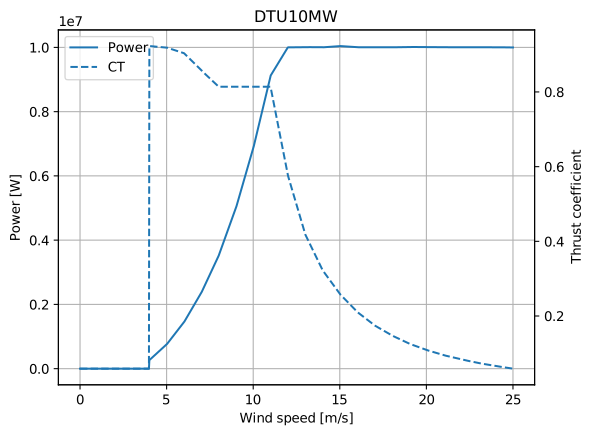
Define turbine type and count:
[4]:
wind_turbines = DTU10MW()
n_wt = 20
wind_turbines.plot_power_ct();
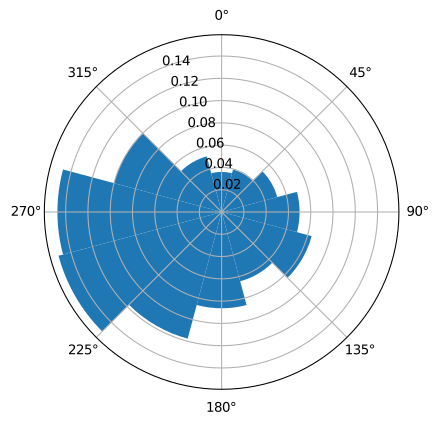
Define the wind resource:
[5]:
site = Hornsrev1Site()
site.plot_wd_distribution();
Define the area:
[6]:
d_west_east = 4000  # [m] width
d_south_north = 2000  # [m] height
min_wt_spacing = 3.5 * wind_turbines.diameter()  # [m] inter-turbine minimum distance
boundary = np.array([
    (0, 0),
    (d_west_east, 0),
    (d_west_east, d_south_north),
    (0, d_south_north),
])
Define the substation position (will also be a design variable in the optimization):
[7]:
x_ss_init, y_ss_init = (d_west_east / 5, d_south_north / 2)
Initial wind farm layout (turbine positions)
[8]:
# Generate initial random turbine layout
x_init, y_init = poisson_disc_filler(
    n_wt,
    min_dist=min_wt_spacing,
    BorderC=boundary,
    seed=42,
    rounds=10,
).T
Build components
AEP component
[9]:
# number of wind directions to consider
n_wd = 12

wfm = Nygaard_2022(site=site, windTurbines=wind_turbines)

aep_comp = PyWakeAEPCostModelComponent(
    windFarmModel=wfm,
    n_wt=n_wt,
    wd=np.linspace(0.0, 360.0, n_wd, endpoint=False),
    objective=False,
)
Electrical network component
Choose the router
Pick one of the available routers in OptiWindNet:
EWRouter
from optiwindnet.api import EWRouter
router = EWRouter()
HGSRouter
from optiwindnet.api import HGSRouter
router = HGSRouter(time_limit=0.1)  # seconds
MILPRouter
from optiwindnet.api import MILPRouter
router = MILPRouter(
    solver_name='gurobi',  # or 'highs', 'cplex'
    time_limit=1,          # seconds
    mip_gap=0.005,         # relative optimality gap (0.5%)
    verbose=True
)
The selected
routeris passed toWFNComponent, which forwards it to OptiWindNet’sWindFarmNetwork. If you useMILPRouter, make sure a supported solver is installed (and licensed if necessary).
Let’s proceed with MILPRouter for this example. You can easily switch to other routers using the sample code above.
[10]:
router = MILPRouter(solver_name='ortools.cp_sat', time_limit=0.1, mip_gap=0.005)
Assemble initial turbine/substation positions in OptiWindNet format.
[11]:
turbines_pos = np.column_stack((x_init, y_init))
substations_pos = np.column_stack(([x_ss_init], [y_ss_init]))
Define cables. Each row is [<max number of turbines this cable can carry>, <cable price in €/m>].
[12]:
cables = np.array([(2, 2000), (5, 2200)])
Build the cabling cost component using TopFarm’s WFNComponent (a thin wrapper around OptiWindNet’s WindFarmNetwork exposing cost and gradient hooks). The component takes turbine and substation coordinates as inputs and outputs cabling_cost (plus the network length and the topology in terse_links).
[13]:
network_cost_comp = WFNComponent(
    turbines_pos=turbines_pos,
    substations_pos=substations_pos,
    cables=cables,
    router=router,
)
Economic component (NPV objective)
We use the costmodels package to assemble a single-technology offshore wind project. DTUOffshoreCostModel provides the technology-level CAPEX/OPEX cost model; Technology wraps it with finance parameters (lifetime, WACC, OPEX, product); Project aggregates technologies into a project that can compute NPV (and IRR, LCOE, CAPEX, OPEX as auxiliaries).
We expose an economic_func (and its analytical gradient economic_func_grad) that takes AEP (in GWh) and cabling_cost (in €) and returns the project NPV. The cabling cost is fed in as shared_capex so it adds to the project CAPEX. Water depth is held fixed across the site for this simple example.
[14]:
LIFETIME = 25         # [years]
EL_PRICE = 60         # [€/MWh] flat PPA price (matches the original notebook's 0.06 €/kWh)
WATER_DEPTH = 33.0    # [m] uniform site water depth
DISTANCE_FROM_SHORE = 30  # [km] (informational — not used by DTUOffshoreCostModel directly)

RP_MW = float(wind_turbines.power(20.0)) * 1e-6  # rated power [MW]

# Reference AEP (used only to seed the model with a plausible capacity factor)
_simres_ref = wfm(x_init, y_init)
_aep_ref_gwh = float(_simres_ref.aep().values.sum())
CF_ref = _aep_ref_gwh * 1e3 / (RP_MW * 24 * 365 * n_wt)

cost_model = DTUOffshoreCostModel(
    rated_power=RP_MW,
    rotor_speed=12.0,
    rotor_diameter=wind_turbines.diameter(),
    hub_height=wind_turbines.hub_height(),
    lifetime=LIFETIME,
    capacity_factor=CF_ref,
    nwt=n_wt,
    profit=0,
)

wind_plant = Technology(
    name='wind',
    lifetime=LIFETIME,
    product=Product.SPOT_ELECTRICITY,
    opex=12600 * n_wt * RP_MW + 1.35 * _aep_ref_gwh * 1000,  # [€/yr]
    wacc=0.06,
    cost_model=cost_model,
)

project = Project(
    technologies=[wind_plant],
    product_prices={Product.SPOT_ELECTRICITY: EL_PRICE},
    depreciation=Depreciation(rate=(0, 1), year=(0, LIFETIME)),
)

water_depth_array = np.full((n_wt,), WATER_DEPTH)
[15]:
def economic_func(AEP, cabling_cost, **kwargs):
    aep_mwh = AEP * 1e3  # GWh → MWh
    npv, aux = project.npv(
        productions={wind_plant.name: aep_mwh},
        cost_model_args={
            wind_plant.name: {'water_depth': water_depth_array, 'aep': aep_mwh},
        },
        finance_args={'shared_capex': cabling_cost},
        return_aux=True,
    )
    return npv, {
        'IRR': aux['IRR'],
        'LCOE': aux['LCOE'][0],
        'CAPEX': aux['CAPEX'],
        'OPEX': float(np.mean(aux['OPEX'])),
    }


def economic_func_grad(AEP, cabling_cost, **kwargs):
    aep_mwh = AEP * 1e3
    grad = project.npv_grad(
        productions={wind_plant.name: aep_mwh},
        cost_model_args={
            wind_plant.name: {'water_depth': water_depth_array, 'aep': aep_mwh},
        },
        finance_args={'shared_capex': cabling_cost},
    )
    return (
        grad[0][wind_plant.name] * 1e3,    # dNPV/dAEP (chain rule for GWh→MWh)
        grad[2]['shared_capex'],           # dNPV/dCablingCost
    )
[16]:
npv_comp = CostModelComponent(
    input_keys=[('AEP', 0.0), ('cabling_cost', 0.0)],
    n_wt=n_wt,
    cost_function=economic_func,
    cost_gradient_function=economic_func_grad,
    output_keys=[('NPV', 0.0)],
    additional_output=[
        ('IRR', 0.0),
        ('LCOE', 0.0),
        ('CAPEX', 0.0),
        ('OPEX', 0.0),
    ],
    objective=True,
    maximize=True,
)
Build TopFarm problem
Combine the three cost components in a TopFarmGroup.
[17]:
cost_comp = TopFarmGroup([
    aep_comp,
    network_cost_comp,
    npv_comp,
])
Create the TopFarmProblem. Design variables are the turbine coordinates x, y and the substation coordinates xs, ys — letting the optimizer co-locate the substation reduces total cabling cost.
[18]:
tf_problem = TopFarmProblem(
    design_vars=dict(
        x=x_init,
        y=y_init,
        xs=x_ss_init,
        ys=y_ss_init,
    ),
    cost_comp=cost_comp,
    constraints=DistanceConstraintAggregation(
        XYBoundaryConstraint(boundary, 'polygon'),
        n_wt,
        min_wt_spacing,
        wind_turbines,
    ),
    driver=EasySGDDriver(maxiter=500),
    plot_comp=XYPlotComp(),
)
Run optimization
We use maxiter=10 here so the example runs quickly end-to-end. Increase it for a meaningful optimization.
[19]:
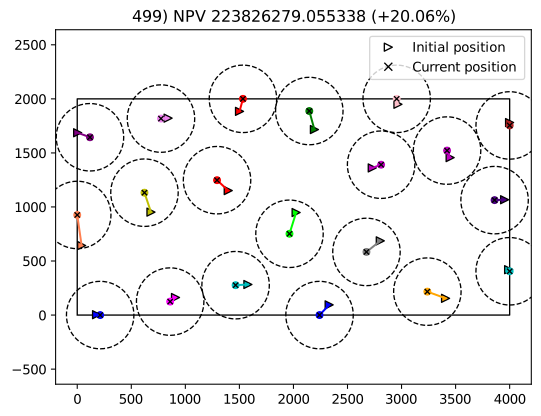
cost, state, recorder = tf_problem.optimize(disp=True)
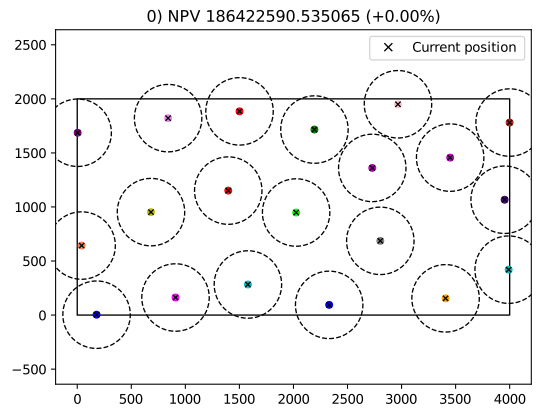
Optimized in 141.805s
Plotting
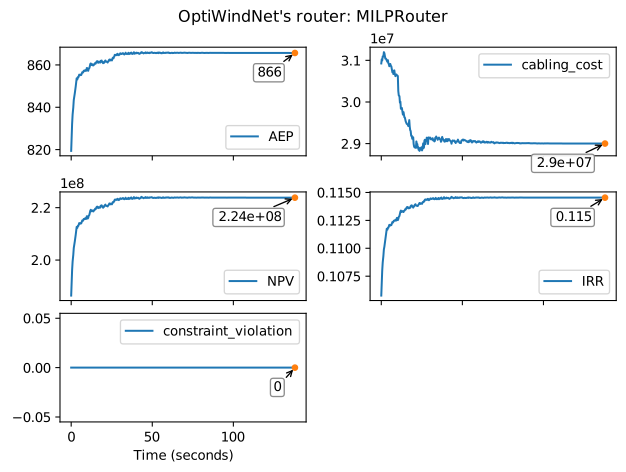
Track AEP, cabling cost, NPV, IRR and constraint violation over time.
[20]:
records_to_plot = ['AEP', 'cabling_cost', 'NPV', 'IRR', 'constraint_violation']
time = recorder['timestamp'] - recorder['timestamp'][0]
n_rows = math.ceil(len(records_to_plot) / 2)
fig, axs = plt.subplots(n_rows, 2, sharex=True, layout='constrained')

for ax, key in zip(axs.ravel(), records_to_plot):
    line, = ax.plot(time, recorder[key], label=key)
    ax.legend()
    x_last, y_last = line.get_xdata()[-1], line.get_ydata()[-1]
    ax.plot(x_last, y_last, 'o', ms=4)
    ax.annotate(
        f'{y_last:.3g}',
        xy=(x_last, y_last),
        xytext=(-10, -10), textcoords='offset points',
        ha='right', va='top',
        arrowprops=dict(arrowstyle='->', lw=1),
        bbox=dict(boxstyle='round,pad=0.2', fc='white', ec='0.5', alpha=0.9),
    )

# hide any unused axes (when records_to_plot is odd)
for ax in axs.ravel()[len(records_to_plot):]:
    ax.set_visible(False)

for ax in axs[-1, :]:
    ax.set_xlabel('Time (seconds)')

fig.suptitle(f"OptiWindNet's router: {type(router).__name__}");
Substation trajectory
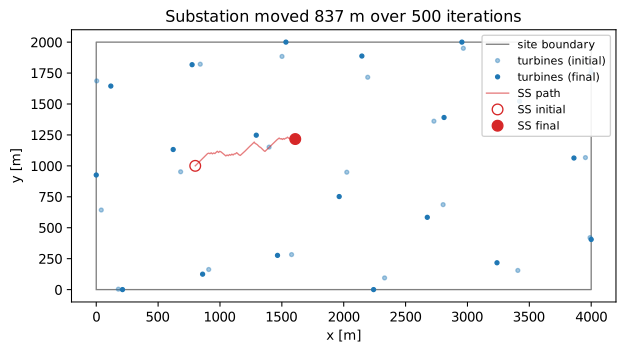
Because xs, ys are design variables (and unconstrained by the site polygon), the substation drifts during optimization. The plot below overlays the site boundary, the initial substation position (open marker), the final position (filled marker), and the path the optimizer took, plus the final turbine layout for context.
[21]:
xs_path = np.asarray(recorder['xs']).reshape(-1)
ys_path = np.asarray(recorder['ys']).reshape(-1)
x_final = np.asarray(recorder['x'])[-1].reshape(-1)
y_final = np.asarray(recorder['y'])[-1].reshape(-1)

fig, ax = plt.subplots(layout='constrained')
ax.set_aspect('equal')

# site boundary
ax.plot(
    np.r_[boundary[:, 0], boundary[0, 0]],
    np.r_[boundary[:, 1], boundary[0, 1]],
    color='0.5', lw=1, label='site boundary',
)

# turbines (initial vs final)
ax.plot(x_init, y_init, '.', color='C0', alpha=0.4, label='turbines (initial)')
ax.plot(x_final, y_final, '.', color='C0', label='turbines (final)')

# substation trajectory
ax.plot(xs_path, ys_path, '-', color='C3', lw=1, alpha=0.6, label='SS path')
ax.plot(xs_path[0], ys_path[0], 'o', mfc='none', mec='C3', ms=8, label='SS initial')
ax.plot(xs_path[-1], ys_path[-1], 'o', mfc='C3', mec='C3', ms=8, label='SS final')

ax.set_xlabel('x [m]')
ax.set_ylabel('y [m]')
ax.legend(loc='upper right', fontsize='small', framealpha=0.9)
ax.set_title(
    f'Substation moved {np.hypot(xs_path[-1] - xs_path[0], ys_path[-1] - ys_path[0]):.0f} m '
    f'over {len(xs_path)} iterations'
);
Plot the optimized network for the final wind farm layout.
[22]:
network_cost_comp.wfn.plot()
[22]:
<Axes: >