

3.3/4/5 Impact/Comparison/Dealing
Sections covered:
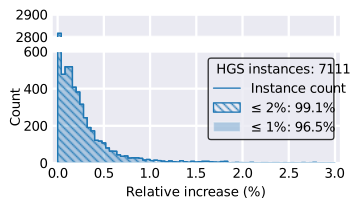
3.3: Impact of detours on the solver’s total length
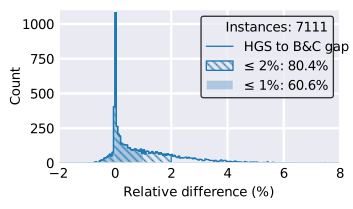
3.4: Comparison of B&C and HGS solutions
3.5: Dealing with crossings from HGS-CVRP
This is used in the paper Flexible cable routing framework for wind farm collection system optimization.
Preamble
[1]:
import matplotlib.pyplot as plt
from matplotlib.lines import Line2D
[2]:
import numpy as np
import polars as pl
[3]:
from optiwindnet.db import modelv2
from optiwindnet.db.storagev2 import G_from_routeset
from optiwindnet.svg import svgplot
[4]:
plt.style.use('jupyter_dark')
[5]:
%config InlineBackend.figure_formats = ['svg']
plt.rcParams['svg.fonttype'] = 'none'
Setup
[6]:
db = modelv2.open_database('data/paperdb.v2.sqlite')
Selecting actual routesets
[7]:
Ns_q = db.NodeSet.select(
    lambda ns:
    ns.name[0] != '!'
)
Ns_q.count()
[7]:
69
[8]:
entries = []
for ns in Ns_q:
    for rs in ns.RouteSets:
        entries.append((
            ns.name,
            rs.id,
            ns.T,
            rs.capacity,
            rs.detextra,
            rs.length,
            rs.creator,
            rs.misc.get('gap', None),
        ))
len(entries)
[8]:
1464
Make DataFrame
[9]:
schema_actual = dict(
    name=str,
    id=int,
    T=int,
    capacity=int,
    detextra=float,
    length=float,
    creator=str,
    gap=float,
)
[10]:
df_actual = pl.DataFrame(entries, schema=schema_actual, orient='row')
[11]:
df_actual
[11]:
shape: (1_464, 8)
| name | id | T | capacity | detextra | length | creator | gap |
|---|---|---|---|---|---|---|---|
| str | i64 | i64 | i64 | f64 | f64 | str | f64 |
| "Gode Wind 1" | 3 | 55 | 6 | null | 59109.208596 | "MILP.pyomo.cplex" | 0.005 |
| "Gode Wind 1" | 202 | 55 | 3 | 0.006098 | 86692.324884 | "MILP.pyomo.cplex" | 0.002397 |
| "Gode Wind 1" | 4153 | 55 | 6 | null | 59786.62999 | "baselines.hgs" | null |
| "Gode Wind 1" | 7 | 55 | 11 | null | 49899.074128 | "MILP.pyomo.cplex" | 0.004998 |
| "Gode Wind 1" | 3620 | 55 | 11 | null | 51682.477491 | "baselines.hgs" | null |
| … | … | … | … | … | … | … | … |
| "Cazzaro-2022" | 21618 | 50 | 8 | 0.02092 | 8.943844 | "baselines.hgs" | null |
| "Cazzaro-2022" | 21627 | 50 | 7 | 0.001865 | 8.730934 | "MILP.pyomo.cplex" | 0.004998 |
| "Cazzaro-2022" | 21621 | 50 | 11 | -1.1102e-16 | 7.753919 | "baselines.hgs" | null |
| "Cazzaro-2022" | 21633 | 50 | 12 | -1.1102e-16 | 7.630594 | "MILP.pyomo.cplex" | 0.004999 |
| "Cazzaro-2022" | 21628 | 50 | 6 | -0.009212 | 9.445058 | "MILP.pyomo.cplex" | 0.004025 |
[12]:
df_actual['name'].value_counts()
[12]:
shape: (69, 2)
| name | count |
|---|---|
| str | u32 |
| "Shengsi 2" | 22 |
| "Global Tech 1" | 22 |
| "Gemini 1" | 22 |
| "Merkur" | 22 |
| "Rødsand 2" | 22 |
| … | … |
| "Dudgeon" | 22 |
| "Moray East.1_OSS" | 22 |
| "Arkona" | 22 |
| "Walney Extension.1_OSS" | 22 |
| "Rampion" | 22 |
[13]:
df_actual['gap'].max()
[13]:
0.019817266284630097
[14]:
df_actual['detextra'].max()
[14]:
0.12263549531666174
[14]:
df_actual['detextra'].max()
[14]:
0.07397519014347398
group ⟨heuri, exact⟩ pairs
[15]:
pairs_actual = []
for ns in Ns_q:
    dfn = df_actual.filter(pl.col('name') == ns.name)
    for k in range(dfn['capacity'].min(), dfn['capacity'].max() + 1):
        dfk = dfn.filter(pl.col('capacity') == k)
        if dfk.height >= 2:
            mask = pl.col('creator') == 'baselines.hgs'
            heuri = dfk.filter(mask).bottom_k(1, by='length')[0]
            exact = dfk.filter(~mask).bottom_k(1, by='gap')[0]
            if exact['gap'].item() <= 0.02:
                pairs_actual.append((db.RouteSet[heuri['id'].item()],
                                     db.RouteSet[exact['id'].item()]))
len(pairs_actual)
[15]:
732
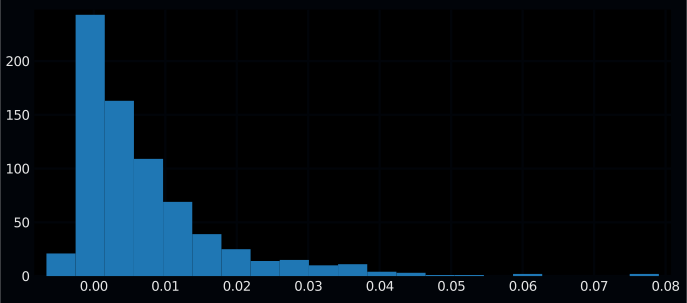
[16]:
diffs = []
for rs_hgs, rs_bnc in pairs_actual:
    diffs.append(rs_hgs.length/rs_bnc.length - 1)
[17]:
for (heuri, exact), diff in zip(pairs_actual, diffs):
    if diff >= 0.07:
        print(heuri.id, exact.id, exact.nodes.name)
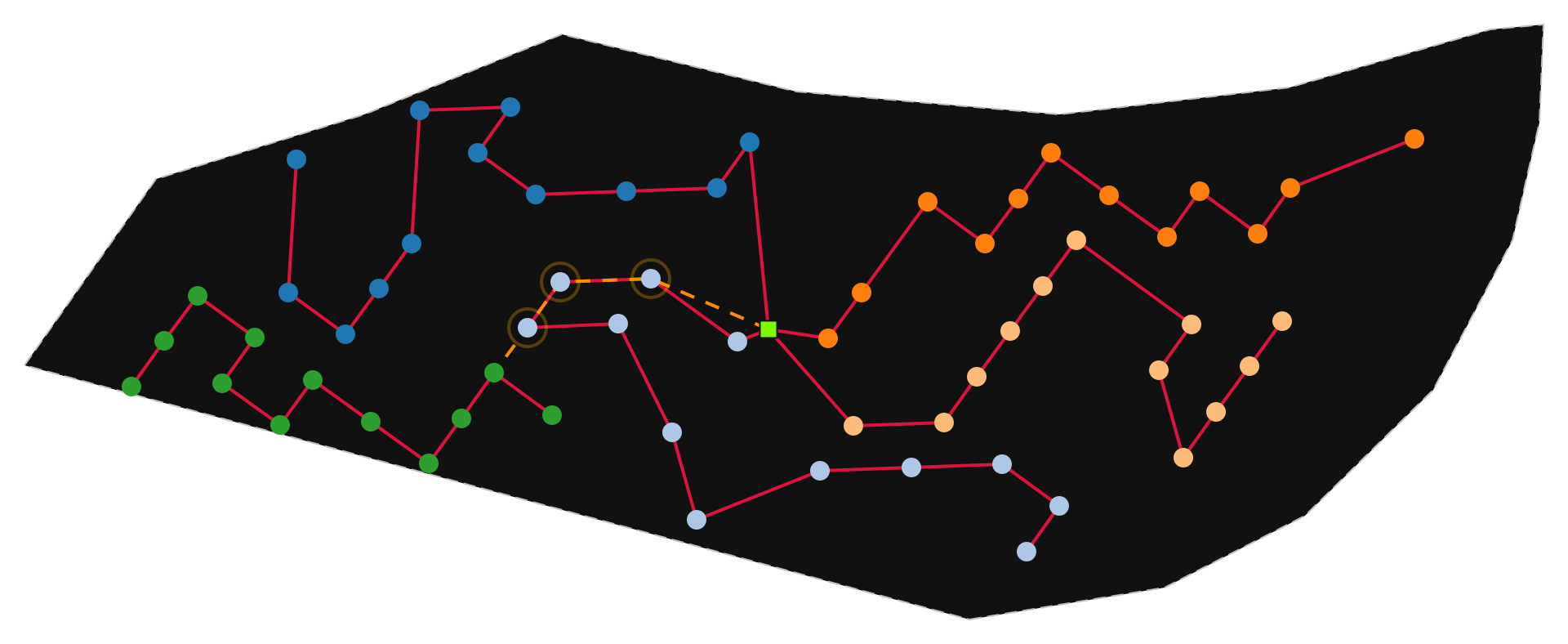
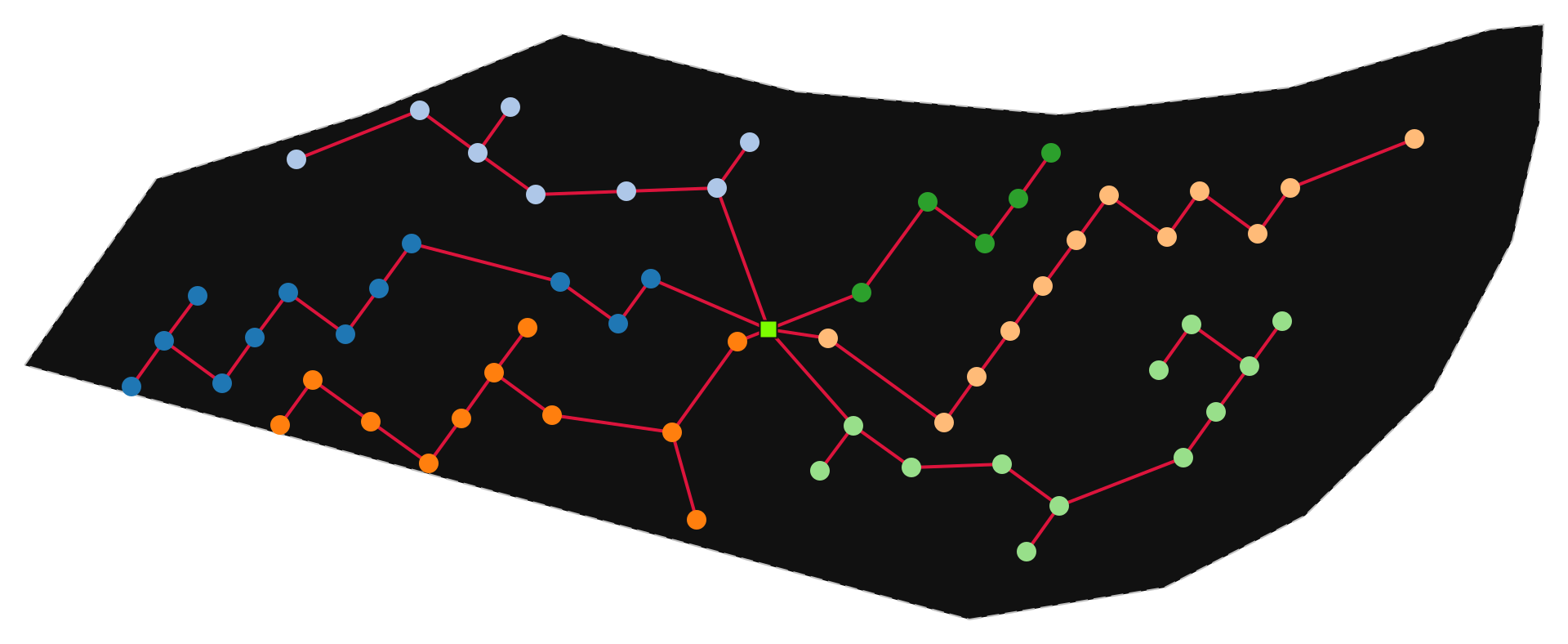
21311 22196 Sandbank
21545 21925 Moray West.1_OSS
[18]:
small_diffs = []
for (heuri, exact), diff in zip(pairs_actual, diffs):
    if diff <= 0.01:
        small_diffs.append((heuri.id, exact.id))
len(small_diffs)
[18]:
540
[19]:
rs = db.RouteSet[21311]
print(rs.detextra)
svgplot(G_from_routeset(rs))
0.07397519014347398
[19]:

[20]:
rs = db.RouteSet[22196]
print(rs.detextra)
svgplot(G_from_routeset(rs))
0.0013995437575948788
[20]:

[21]:
rs = db.RouteSet[21545]
print(rs.detextra)
svgplot(G_from_routeset(rs))
0.02038470064164777
[21]:
[22]:
rs = db.RouteSet[21925]
print(rs.detextra)
svgplot(G_from_routeset(rs))
None
[22]:
[23]:
plt.hist(diffs, bins=21);
HGS optimizer
Select HGS-CVRP entries
[24]:
method_hgs = db.Method.select(
    lambda m:
    m.funname == 'hgs_cvrp'
    and m.options['timeLimit'] == 120
)
method_hgs.count()
[24]:
2
[25]:
for m in method_hgs:
    print(m.funname, m.options)
hgs_cvrp {'complete': False, 'lambda_': 40, 'mu': 25, 'nbClose': 5, 'nbElite': 4, 'nbGranular': 20, 'nbIter': 20000, 'scale': 10000.0, 'seed': 0, 'targetFeasible': 0.2, 'timeLimit': 120.0, 'useSwapStar': True}
hgs_cvrp {'complete': False, 'lambda_': 40, 'mu': 25, 'nbClose': 5, 'nbElite': 4, 'nbGranular': 20, 'nbIter': 20000, 'seed': 20241113, 'targetFeasible': 0.2, 'timeLimit': 120, 'useSwapStar': True}
synthetic instances (a single capacity per NodeSet)
[26]:
pairs_synth = []
[27]:
# hgs instances that were first solved by cplex
hgs_sub2 = db.RouteSet.select(
    lambda rs:
    rs.method in method_hgs
    and 'solver_details' in rs.misc
    and 'incumbent_id' in rs.misc['solver_details']
    and rs.valid is None
    # and rs.nodes.name != 'Ormonde'
    and rs.nodes.name[0] == '!'
    and rs.T >= 50
)
# keep only instances for which the exact solution is within 2% gap
for rs_hgs in hgs_sub2:
    rs_bnc = db.RouteSet[rs_hgs.misc['solver_details']['incumbent_id']]
    # if rs_bnc.misc['bound']/rs_bnc.length >= 0.98:
    if rs_bnc.misc['gap'] <= 0.02:
        pairs_synth.append((rs_hgs, rs_bnc))
hgs_sub2.count(), len(pairs_synth)
[27]:
(2346, 2346)
[28]:
# hgs instances that were solved by cplex afterward
hgs_sub2_ = db.RouteSet.select(
    lambda rs:
    rs.method in method_hgs
    and 'solver_details' not in rs.misc
    and rs.valid is None
    and rs.nodes.name[0] == '!'
    and rs.T >= 50
)
# keep only instances for which the exact solution is within 2% gap
for rs_hgs in hgs_sub2_:
    if len(rs_hgs.nodes.RouteSets) == 1:
        # no MILP counterpart
        continue
    cplex = gurobi = None
    for rs2 in rs_hgs.nodes.RouteSets:
        if rs2 is rs_hgs:
            continue
        if rs2.creator == 'MILP.pyomo.cplex':
            cplex = rs2
        elif rs2.creator == 'MILP.pyomo.gurobi':
            gurobi = rs2
    if gurobi and gurobi.misc['gap'] <= 0.02:
        pairs_synth.append((rs_hgs, gurobi))
    elif cplex and cplex.misc['gap'] <= 0.02:
        pairs_synth.append((rs_hgs, cplex))
hgs_sub2_.count(), len(pairs_synth)
[28]:
(4033, 6379)
[29]:
len(pairs_actual) + len(pairs_synth)
[29]:
7111
Check if there are NodeSets counted multiple times
[30]:
len(pairs_synth)
[30]:
6379
[31]:
once = set()
twice = set()
for rs_hgs, rs_bnc in pairs_synth:
    assert rs_hgs.nodes is rs_bnc.nodes, (rs_hgs.nodes.name, rs_bnc.nodes.name)
    if rs_hgs.nodes.digest in once:
        if rs_hgs.nodes.digest in twice:
            print(f'more than twice: {rs_hgs.nodes.name}')
        twice.add(rs_hgs.nodes.digest)
    else:
        once.add(rs_hgs.nodes.digest)
len(once), len(twice)
[31]:
(6379, 0)
Make DataFrame
[32]:
schema_hgs = dict(
    id=int,
    synthetic=bool,
    T=int,
    capacity=int,
    detextra=float,
    length=float,
    # incumbent=float,
    # incumbent_bound=float,
    exact_bound=float,
    # incumbent_id=int,
)
[33]:
data = []
for rs_hgs, rs_bnc in pairs_actual + pairs_synth:
    data.append(dict(
        id=rs_hgs.id,
        synthetic=rs_hgs.nodes.name[0] == '!',
        T=rs_hgs.T,
        capacity=rs_hgs.capacity,
        detextra=rs_hgs.detextra,
        length=rs_hgs.length,
        exact_bound=rs_bnc.misc['bound'],
    ))
    # print(details['incumbent_id'], end=' ')
df_hgs = pl.DataFrame(data, schema=schema_hgs)
[34]:
df_hgs.columns
[34]:
['id', 'synthetic', 'T', 'capacity', 'detextra', 'length', 'exact_bound']
[35]:
df_hgs['synthetic'].value_counts()
[35]:
shape: (2, 2)
| synthetic | count |
|---|---|
| bool | u32 |
| false | 732 |
| true | 6379 |
[36]:
df_hgs['detextra'].describe()
[36]:
shape: (9, 2)
| statistic | value |
|---|---|
| str | f64 |
| "count" | 5129.0 |
| "null_count" | 1982.0 |
| "mean" | 0.003079 |
| "std" | 0.005495 |
| "min" | -0.018452 |
| "25%" | 0.000774 |
| "50%" | 0.001803 |
| "75%" | 0.003515 |
| "max" | 0.118956 |
[37]:
detextra_hgs = np.sort(np.nan_to_num(np.clip(df_hgs['detextra'], 0., None), nan=0.))
[38]:
# Negative detextra in hgs is OK.
# It means some subtree roots chosen by PathFinder were closer to root
# than the path's head (since PathFinder relaxes the path-subtree constraint)
df_hgs.filter(pl.col('detextra') < -1e-3)
[38]:
shape: (35, 7)
| id | synthetic | T | capacity | detextra | length | exact_bound |
|---|---|---|---|---|---|---|
| i64 | bool | i64 | i64 | f64 | f64 | f64 |
| 21006 | false | 60 | 10 | -0.002975 | 51296.546654 | 49611.477292 |
| 21209 | false | 55 | 2 | -0.003444 | 182175.265645 | 182804.81475 |
| 21208 | false | 55 | 4 | -0.001266 | 99909.593562 | 99531.718807 |
| 21556 | false | 119 | 2 | -0.017189 | 405793.043417 | 412587.411775 |
| 21557 | false | 119 | 3 | -0.007867 | 291621.821448 | 292531.694887 |
| … | … | … | … | … | … | … |
| 16186 | true | 70 | 10 | -0.009745 | 7.983239 | 7.73576 |
| 16857 | true | 50 | 4 | -0.003896 | 8.106149 | 8.051141 |
| 17139 | true | 133 | 10 | -0.002333 | 12.255932 | 11.63741 |
| 17696 | true | 68 | 8 | -0.012723 | 8.916369 | 8.541159 |
| 17764 | true | 57 | 4 | -0.001816 | 10.979295 | 10.874424 |
B&C solver
Make DataFrame
[39]:
schema_exact = dict(
    id=int,
    synthetic=bool,
    T=int,
    capacity=int,
    detextra=float,
    length=float,
    bound=float,
)
[40]:
data = []
for rs_hgs, rs_bnc in pairs_actual + pairs_synth:
    data.append(dict(
        id=rs_bnc.id,
        synthetic=rs_bnc.nodes.name[0] == '!',
        T=rs_bnc.T,
        capacity=rs_bnc.capacity,
        detextra=rs_bnc.detextra,
        length=rs_bnc.length,
        bound=rs_bnc.misc['bound'],
    ))
df_BnC = pl.DataFrame(data, schema=schema_exact)
[41]:
df_BnC.height
[41]:
7111
[42]:
df_BnC['detextra'].describe()
[42]:
shape: (9, 2)
| statistic | value |
|---|---|
| str | f64 |
| "count" | 4949.0 |
| "null_count" | 2162.0 |
| "mean" | 0.002359 |
| "std" | 0.004466 |
| "min" | -0.009212 |
| "25%" | 0.000637 |
| "50%" | 0.001591 |
| "75%" | 0.003006 |
| "max" | 0.122635 |
[43]:
detextra_BnC = np.sort(np.nan_to_num(np.clip(df_BnC['detextra'], 0., None), nan=0.))
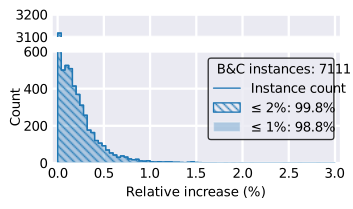
3.3 Impact of detours on the solver’s total length
[45]:
with plt.style.context('pdf_1col'):
    data = 100*detextra_BnC

    fig, (ax1, ax2) = plt.subplots(2, 1, height_ratios=[1, 5], figsize=(3.5, 2),
                                   facecolor='w', sharex=True)
    # fig.subplots_adjust(hspace=0.05)
    ax1.spines.bottom.set_visible(False)
    ax1.xaxis.tick_top()
    ax1.tick_params(labeltop=False)
    num_data = len(data)
    below1 = data <= 1
    below2 = data <= 2
    bins = np.linspace(0, 3, num=76)
    # bins = None

    # top y_axis segment
    H1, X1, art1_ = ax1.hist(data[below1], bins = bins, color='tab:blue',
                             histtype='stepfilled', alpha=0.3)
    H2, X2, art2_ = ax1.hist(data[below2], bins = bins, edgecolor='tab:blue',
                             histtype='stepfilled', hatch=r'\\\\', facecolor='none')
    H, X, art_ = ax1.hist(data, bins = bins, color='tab:blue', histtype='step')

    # main y_axis segment
    H1, X1, art1_ = ax2.hist(data[below1], bins = bins, color='tab:blue',
                             histtype='stepfilled', alpha=0.3)
    H2, X2, art2_ = ax2.hist(data[below2], bins = bins, edgecolor='tab:blue',
                             histtype='stepfilled', hatch=r'\\\\', facecolor='none')
    H, X, art_ = ax2.hist(data, bins = bins, color='tab:blue', histtype='step')

    ax1.set_ylim(3100, 3200)  # outliers only
    ax2.set_ylim(0, 600)  # most of the data

    C1, C2 = H1.sum(), H2.sum()
    leg = ax2.legend(  # the empty Line2D is a hack to get a line instead of a patch
        [Line2D([], []), art2_[0], art1_[0]],
        ['Instance count',
         f'≤ 2%: {100*C2/num_data:.1f}%',
         f'≤ 1%: {100*C1/num_data:.1f}%'],
        title=f'B&C instances: {num_data}'
    )
    ax2.set_ylabel('Count')
    ax2.set_xlabel('Relative increase (%)')
    leg.legend_handles[0] = Line2D([], [])
    ax1.figure.savefig('fig_detextra_BnC.pdf', transparent=False)
    pass
[46]:
with plt.style.context('pdf_1col'):
# with plt.style.context('pub_paperfarm'):
# if True:
    data = 100*detextra_hgs

    fig, (ax1, ax2) = plt.subplots(2, 1, height_ratios=[1, 5], figsize=(3.5, 2),
                                   facecolor='w', sharex=True)
    # fig.subplots_adjust(hspace=0.05)
    ax1.spines.bottom.set_visible(False)
    ax1.xaxis.tick_top()
    ax1.tick_params(labeltop=False)
    num_data = len(data)
    below1 = data <= 1
    below2 = data <= 2
    bins = np.linspace(0, 3, num=76)
    # bins = None

    # top y_axis segment
    H1, X1, art1_ = ax1.hist(data[below1], bins = bins, color='tab:blue',
                             histtype='stepfilled', alpha=0.3)
    H2, X2, art2_ = ax1.hist(data[below2], bins = bins, edgecolor='tab:blue',
                             histtype='stepfilled', hatch=r'\\\\', facecolor='none')
    H, X, art_ = ax1.hist(data, bins = bins, color='tab:blue', histtype='step')

    # main y_axis segment
    H1, X1, art1_ = ax2.hist(data[below1], bins = bins, color='tab:blue',
                             histtype='stepfilled', alpha=0.3)
    H2, X2, art2_ = ax2.hist(data[below2], bins = bins, edgecolor='tab:blue',
                             histtype='stepfilled', hatch=r'\\\\', facecolor='none')
    H, X, art_ = ax2.hist(data, bins = bins, color='tab:blue', histtype='step')

    ax1.set_ylim(2800, 2900)  # outliers only
    ax2.set_ylim(0, 600)  # most of the data

    C1, C2 = H1.sum(), H2.sum()
    leg = ax2.legend(  # the empty Line2D is a hack to get a line instead of a patch
        [Line2D([], []), art2_[0], art1_[0]],
        ['Instance count',
         f'≤ 2%: {100*C2/num_data:.1f}%',
         f'≤ 1%: {100*C1/num_data:.1f}%'],
        title=f'HGS instances: {num_data}'
    )
    ax2.set_ylabel('Count')
    ax2.set_xlabel('Relative increase (%)')
    leg.legend_handles[0] = Line2D([], [])
    ax1.figure.savefig('fig_detextra_HGS.pdf', transparent=False)
    pass
3.4 Comparison of B&C and HGS solutions
[47]:
with plt.style.context('pdf_1col'):
    data_HGSvsBnC_gap = 1 - df_BnC['length']/df_hgs['length']
    data = 100*data_HGSvsBnC_gap.to_numpy()

    fig, ax = plt.subplots(facecolor='w', figsize=(3.5, 2))
    num_data = len(data)
    below1 = data <= 1
    below2 = data <= 2
    elsewhere = data > 2
    bins = np.linspace(-2, 8, num=201)

    # main y_axis segment
    H1, X1, art1_ = ax.hist(data[below1], bins = bins, color='tab:blue',
                             histtype='stepfilled', alpha=0.3)
    H2, X2, art2_ = ax.hist(data[below2], bins = bins, edgecolor='tab:blue',
                             histtype='stepfilled', hatch=r'\\\\', facecolor='none')
    H, X, art_ = ax.hist(data, bins = bins, color='tab:blue', histtype='step')

    C1, C2 = H1.sum(), H2.sum()
    leg = ax.legend(  # the empty Line2D is a hack to get a line instead of a patch
        [Line2D([], []), art2_[0], art1_[0]],
        ['HGS to B&C gap',
         f'≤ 2%: {100*C2/num_data:.1f}%',
         f'≤ 1%: {100*C1/num_data:.1f}%'],
        title=f'Instances: {num_data}'
    )
    ax.set_ylabel('Count')
    ax.set_xlabel('Relative difference (%)')
    leg.legend_handles[0] = Line2D([], [])
    ax.set_xlim(-2, 8)
    ax.figure.savefig('fig_HGS_to_BnC_gap.pdf', transparent=False)
    pass
3.5 Dealing with crossings from HGS-CVRP
Select HGS-CVRP entries
[48]:
df_hgs.height
[48]:
7111
[49]:
method_hgs = db.Method.select(
    lambda m:
    m.funname == 'hgs_cvrp'
    and m.options['timeLimit'] == 120
)
[50]:
method_hgs.count()
[50]:
2
[51]:
hgs_all = db.RouteSet.select(
    lambda rs:
    rs.method in method_hgs
)
hgs_all.count()
[51]:
7044
[52]:
hgs_invalid = hgs_all.filter(
    lambda rs:
    rs.valid is False
)
hgs_invalid.count()
[52]:
0
[53]:
# just the instances repaired after the first hgs run
hgs_repaired = hgs_all.filter(
    lambda rs:
    rs.valid is None  # provisory valid marker
    and 'repaired' in rs.misc
    and 'hgs_reruns' not in rs.misc
)
hgs_repaired.count()
[53]:
332
[54]:
hgs_reruns = hgs_all.filter(
    lambda rs:
    rs.valid is None  # provisory valid marker
    and 'hgs_reruns' in rs.misc
)
hgs_reruns.count()
[54]:
98
Statistics
[55]:
hgs_all = db.RouteSet.select(
    lambda rs:
    rs.creator == 'baselines.hgs'
    # rs.method.solver_name == 'HGS-CVRP'
    # and rs.method.options['timeLimit'] == 120
)
hgs_all.count()
[55]:
7111
[56]:
# just the instances repaired after the first hgs run
hgs_repaired = hgs_all.filter(
    lambda rs:
    rs.valid is None  # provisory valid marker
    and 'repaired' in rs.misc
    and 'hgs_reruns' not in rs.misc
)
hgs_repaired.count()
[56]:
332
[57]:
hgs_reruns = hgs_all.filter(
    lambda rs:
    rs.valid is None  # provisory valid marker
    and 'hgs_reruns' in rs.misc
)
hgs_reruns.count()
[57]:
98
[58]:
(hgs_repaired.count() + hgs_reruns.count())/hgs_all.count()
[58]:
0.06046969483898186
[59]:
hgs_repaired.count()/hgs_all.count()
[59]:
0.04668822950358599
[60]:
hgs_reruns.count()/hgs_all.count()
[60]:
0.013781465335395865
Examining re-runs
[61]:
subcounts = []
for reruns in range(1, 10):
    count = hgs_reruns.filter(
        lambda rs:
        rs.misc['hgs_reruns'] == reruns
    ).count()
    subcounts.append(count)
    print(reruns, count, count/hgs_all.count())
1 81 0.011390802981296582
2 12 0.0016875263675994938
3 2 0.0002812543945999156
4 1 0.0001406271972999578
5 2 0.0002812543945999156
6 0 0.0
7 0 0.0
8 0 0.0
9 0 0.0
[62]:
total = sum(subcounts)
for reruns, count in zip(range(1, 10), subcounts):
    print(reruns, f'{100*count/total:.1f}%')
1 82.7%
2 12.2%
3 2.0%
4 1.0%
5 2.0%
6 0.0%
7 0.0%
8 0.0%
9 0.0%