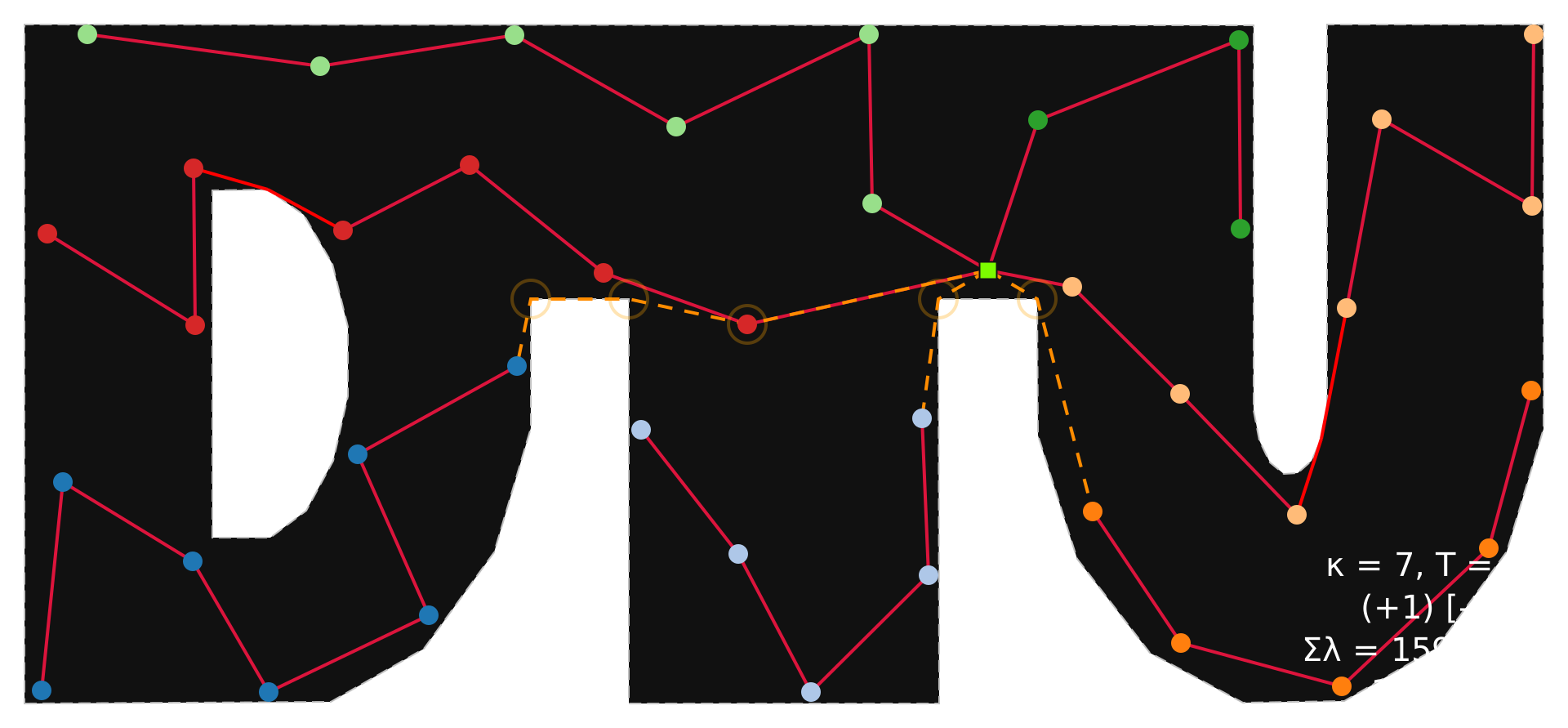
HGSRouter example
This notebook uses OptiWindNet to route the collector system cables via HGSRouter.
🧬 HGS (Hybrid Genetic Search)
HGSRouter is a metaheuristic based router that applies Hybrid Genetic Search (HGS) to optimize electrical network of a defined turbine-layout as a Capacitated Vehicle Routing Problem (CVRP). It can handle both single and multiple substations and is well-suited for fast and high-quality networks.
This router is slower than EWRouter but typically yields better-quality solutions, especially for medium and large windfarms with one substation.
🔧 Constructor: HGSRouter(...)
Required arguments:
Argument |
Type |
Description |
|---|---|---|
|
|
Time limit (in seconds) which controls how long the genetic algorithm can search for better solutions. |
Optional arguments:
Argument |
Type |
Description |
|---|---|---|
|
|
Maximum number of feeders (only used in single-substation problems). |
|
|
Maximum number of local iterations (default: |
|
|
If |
|
|
Random seed for reproducibility (default: |
|
|
If |
✅ Example
router = HGSRouter(time_limit=60, feeder_limit=10, balanced=True)
wf = WindFarmNetwork(cables=..., turbinesC=..., substationsC=..., router=router)
wf.optimize()
HGSRouter trades speed for higher-quality networks and is particularly useful when:
A better solution is worth longer runtime (respect to
EWRouter)The number of turbines connected to each feeder needs to be balanced
In multi-substation networks, the
feeder_limitis ignored (not yet supported).
This router is implemented vidalt/HGS-CVRP: Modern implementation of the hybrid genetic search (HGS) algorithm specialized to the capacitated vehicle routing problem (CVRP). This code also includes an additional neighborhood called SWAP*.
HGSRouter can only produce radial topologies. Since a radial topology is a special case of the branched topology, solutions produced by this method can be used to warm-start both branched- and radial-topology models.
Load data
import required modules
[13]:
from optiwindnet.api import WindFarmNetwork, HGSRouter
[14]:
# Display figures as SVG in Jupyter notebooks
%config InlineBackend.figure_formats = ['svg']
Create an instance of wfn using .from_pbf()
[15]:
wfn = WindFarmNetwork.from_pbf(filepath='data/DTU_letters.osm.pbf', cables= [(7, 2000.0)])
[16]:
wfn
[16]:

Optimize with HGSRouter
[17]:
router = HGSRouter(time_limit=10)
[18]:
res = wfn.optimize(router=router)
[19]:
wfn.length()
[19]:
1596.158040734816
Get solution_time
We can see the solution time for HGS using:
wfn.S.graph['solution_time']
It prints the computation time for each subgroup of turbines assigned to a specific substation. The HGS algorithm groups turbines and allocates each group to a substation prior to optimization.
[20]:
print(wfn.S.graph['solution_time'])
0.06
Choosing time_limit wisely
Based on the solution times observed in the previous step, we can make an informed decision about the time limit for the HGS router. If increasing the time limit does not significantly improve the solution (e.g., does not result in a noticeably shorter cable length), we can consider reducing it to save computational resources. In this case, a time limit of 0.1 second appears to be sufficient, as it is well above all the solution times.
[21]:
router_reduced_timelimit = HGSRouter(time_limit=0.1)
res_reduced_timelimit = wfn.optimize(router=router_reduced_timelimit)
[22]:
print(wfn.S.graph['solution_time'])
0.05
Check the length
We can see that, as expected, reducing the time limt from 10 seconds to 1 seconds has not affected the resultant length.
[23]:
wfn.length()
[23]:
1596.158040734816
Plot the Optimized Network Graph
[24]:
wfn
[24]: